
Today’s hospitality businesses are often judged before guests even interact with a member of staff. Slow internet / Wi-Fi, failed card payments, or unanswered phone calls can quickly impact the customer experience, leading to negative reviews, fewer repeat bookings, and lost revenue.
For hotels, restaurants, pubs, cafés, holiday parks and other hospitality venues, internet connectivity is no longer an option, it sits at the heart of the guest experience and supports many of the systems businesses rely on every day.
From guest Wi-Fi and online bookings to point of sale (POS) terminals and digital phone systems, a poor connection can quickly affect cause a number of issues including affecting your customer’s experience.
Guest Wi-Fi: More Than Just an Extra Service
Point of Sale Systems Depend on Connectivity
Customers check emails, use social media, stream content or even work remotely while visiting hospitality venues.
If guest Wi-Fi is slow or frequently disconnects, it can lead to:
- Negative online reviews
- Lower customer satisfaction scores
- Increased complaints to staff
- Guests choosing competitors for future visits
A well-designed guest Wi-Fi network should provide strong coverage throughout the property, manage bandwidth effectively and keep guest traffic separate from business systems for security reasons.
Modern POS systems often rely on cloud-based services to process payments, update inventory and generate reports.
When internet connectivity becomes unstable, businesses may experience:
- Delayed card transactions
- Failed payments
- Longer queues at busy periods
- Incorrect stock updates
- Difficulty accessing sales data
In a restaurant or bar environment, even a short outage during peak service can create significant disruption and lost income.
The Importance of Reliable Phone Systems
Many hospitality businesses now use digital or VoIP phone systems which run over the internet. These systems offer flexibility and advanced features, but they also depend on a stable internet connection.
If connectivity fails, businesses may be unable to:
- Take reservations
- Handle guest enquiries
- Communicate between departments
- Respond quickly to customer issues
For hotels and larger venues, phone availability is particularly important for guest safety and customer service.
Why a Backup or Failover Connection Is Essential
Many hospitality businesses only discover how dependent they are on the internet when the connection goes down.
A backup or failover solution provides an alternative connection if the primary service fails. This could be delivered through:
- 4G or 5G mobile connectivity
- A secondary broadband circuit
- Fixed wireless access
- Satellite connectivity in remote locations
With automatic failover in place, critical services such as payment terminals, booking systems and phone lines can continue working even during an outage.
Why failover matters
Business continuity: The cost of a backup connection is often far lower than the cost of a busy evening without card payments or booking access
Common Problems Caused by Poor Connectivity
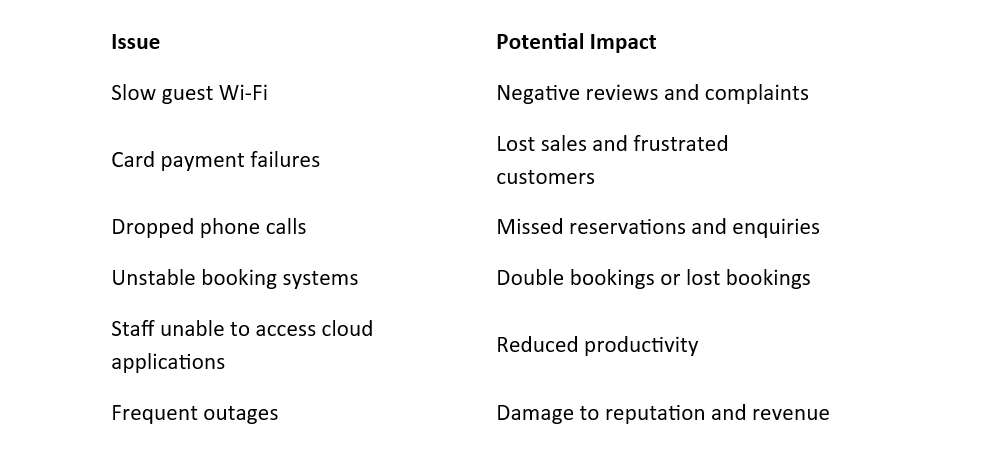
Other systems and processes which may also be affected include; Property Management Systems (PMS), Booking Engines, Door access systems, CCTV, Staff handheld ordering devices, Kitchen Display Systems, Digital signage, IPTV, Smart room technology, Environmental monitoring, Stock management etc.
The Financial Cost of Poor Connectivity
Reliable connectivity isn’t just an IT issue; it’s a business issue. Every internet outage, dropped call or failed payment has the potential to affect your bottom line.
For hospitality businesses, connectivity directly influences key performance indicators such as revenue, occupancy rates, table turnover, guest satisfaction and repeat bookings. When systems fail, the financial impact can be immediate. A restaurant that cannot process card payments or accept online bookings risks losing customers to competitors, while a hotel with poor internet and/or Wi-Fi may receive negative reviews that deter future guests.
Even seemingly minor issues can have a cumulative effect. A missed reservation because the phone system is unavailable, delays at the point of sale, or guests unable to access reliable Wi-Fi can all reduce customer satisfaction and ultimately impact profitability.
For example, if a 100-room hotel loses just two bookings per week due to poor guest reviews linked to unreliable connectivity, the annual revenue loss could run into tens of thousands of pounds. Likewise, a busy restaurant experiencing payment or internet issues during peak service may lose valuable table turnover, reducing revenue during its busiest trading periods.
Investing in resilient, high-performance internet and telephony is therefore about far more than keeping systems online, it’s about protecting revenue, maintaining your reputation, and ensuring every guest enjoys the experience they expect.
The Connected Customer Journey
Today’s guest journey is almost entirely digital, with reliable connectivity playing a role at every stage of their experience. From the moment a hospitality customer discovers your business to the point they leave a review; every interaction relies on your internet and telephony systems working perfectly.
Consider a typical guest journey. A customer books their stay or table online, receives a confirmation email or text message, contacts reception with a query before arrival, checks in using a digital booking system, connects to the guest Wi-Fi, orders food and drinks through electronic point-of-sale systems, pays by card, and perhaps contacts reception during their stay. Finally, after they’ve left, they’re likely to share their experience through an online review or recommend your business to others.
Every one of these touchpoints depends on reliable connectivity.
If the internet is slow, the booking system is unavailable, payment terminals fail, phones go unanswered or guest Wi-Fi performs poorly, the customer experience begins to suffer. While each issue may seem minor in isolation, together they can leave a lasting negative impression that affects guest satisfaction and potentially repeat business.
As hospitality businesses continue to embrace digital technology, connectivity is no longer simply supporting the customer journey, it has become an integral part of it. Investing in resilient internet and telephony helps ensure every interaction is smooth, professional and memorable for the right reasons.
How to Rectify Connectivity Issues
If your hospitality business is experiencing connectivity problems, there are several steps worth considering:
Review your current broadband service
Check whether the connection speed and bandwidth are suitable for the number of guests, devices and business applications you use.
Assess Wi-Fi coverage
Dead spots and weak signal areas can often be improved with additional access points and a professionally designed Wi-Fi network.
Separate guest and business traffic
Keeping guest Wi-Fi separate from POS systems and business applications helps improve security and performance.
Implement a backup connection
Add a failover service using 4G, 5G or a secondary circuit to maintain connectivity during outages.
Monitor network performance
Proactive monitoring can identify issues before they become major problems for guests and staff.
Upgrade outdated phone systems
Modern hosted phone systems can provide greater flexibility, call reporting and business continuity features.
Planning for Busy Periods
Hospitality venues often experience significant spikes in demand during weekends, holidays and events. A connection that performs adequately during quieter periods may struggle when hundreds of guests are connected at the same time.
Capacity planning is therefore essential. Businesses should consider:
- Expected guest numbers
- Number of connected devices
- Streaming and video usage
- Cloud-based business applications
- Payment processing requirements
- Future growth plans
How Orbital Net Supports the Hospitality Sector
The digital switchover is an ideal opportunity for hospitality businesses to review their existing connectivity and ensure it is fit for purpose. Rather than simply replacing analogue phone lines, operators should take the time to assess whether their internet connection, Wi-Fi coverage and communications infrastructure are capable of supporting both current tasks and future growth.
It’s also worth reviewing areas such as guest Wi-Fi performance, network resilience, backup connectivity, and cybersecurity. As more day-to-day processes become cloud-based, ensuring your systems are reliable, secure and scalable can help minimise disruption, improve the guest experience and support your business continuity.
Working with experienced telecoms and IT providers can help identify any weaknesses before they become problems. A full connectivity audit can highlight legacy equipment, assess Wi-Fi coverage throughout the premises, review failover options and ensure essential systems are suitable.
Taking a proactive approach now will not only help businesses prepare for the 2027 digital switchover but also provide useful insights into how to stay ahead with their connectivity. If you are looking for a connectivity audit, then please get in touch via our contact page and we will be happy to discuss a free audit.
Calla Marenghi, Orbital Net – Marketing Campaign Manager